Which systems are the titanate coupling agents and aluminate coupling agents suitable for? What are the advantages and disadvantages?
Titanate coupling agents and aluminate coupling agents are suitable for different systems, and both have their own advantages and disadvantages. The details are as follows:
Suitable systems
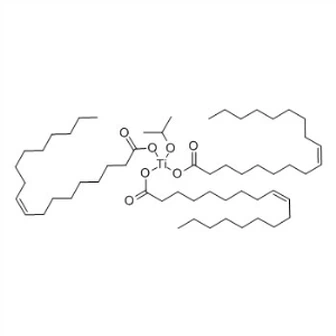
Filling systems with high filler content: Such as in plastics filled with calcium carbonate, talc, and other inorganic fillers. Titanate coupling agents can improve the dispersion of fillers in the polymer matrix, enhance the interfacial bonding, and reduce the viscosity of the composite material, which is beneficial to the processing of the material.
Thermoplastic polymer systems: They have good compatibility with thermoplastic resins such as polyethylene, polypropylene, and polyvinyl chloride. They can improve the impact strength, tensile strength, and other mechanical properties of thermoplastic composites.
Some coating systems: They can be used in coatings to improve the adhesion of pigments and fillers to the coating matrix, enhance the weather resistance and mechanical properties of the coating film.
Advantages
Strong coupling effect: It can form a chemical bond with the surface of inorganic fillers and has a good interaction with organic polymers, effectively improving the interface bonding strength.
Good dispersion: It can significantly improve the dispersion of fillers in polymers, making the distribution of fillers more uniform, which is beneficial to improving the performance of materials.
Function adjustment: Different types of titanate coupling agents can be selected according to different application requirements to achieve specific functions such as improving hydrophobicity or enhancing thermal stability.
Disadvantages
Sensitivity to hydrolysis: Some titanate coupling agents are easily hydrolyzed in the presence of water, which requires attention to moisture - proof during storage and use. Otherwise, the hydrolysis will affect its coupling effect.
Limited thermal stability: Under high - temperature conditions, some titanate coupling agents may decompose or volatilize, affecting their performance in high - temperature processing processes.
High cost: Compared with some other coupling agents, the cost of titanate coupling agents is relatively high, which may increase the production cost of materials.
Aluminate coupling agents
Suitable systems
General - purpose plastic systems: Such as polyethylene, polypropylene, and other common plastics. Aluminate coupling agents can improve the filling performance of inorganic fillers in these plastics, enhance the mechanical properties and processing performance of materials.
Rubber systems: In the rubber industry, it can be used to treat fillers such as carbon black and silica, improve the dispersion of fillers in rubber, and enhance the cross - linking degree and mechanical properties of rubber.
Some water - based coating systems: It has good compatibility with water - based resins and can be used in water - based coatings to improve the dispersion and adhesion of pigments and fillers.
Advantages
Good comprehensive performance: It has a certain coupling effect, which can improve the interface bonding between inorganic fillers and organic matrices to a certain extent, and at the same time improve the mechanical properties and processing performance of materials.
Low cost: Compared with titanate coupling agents, the cost of aluminate coupling agents is relatively low, which has a greater cost - performance advantage in large - scale industrial applications.
Good stability: It has better stability in the environment, is not easy to be affected by moisture and temperature, and is easy to store and use.
Disadvantages
Relatively weak coupling ability: The coupling effect is relatively weak compared with titanate coupling agents. In some high - performance material systems that require high - strength interface bonding, its use effect may be limited.
Limited modification effect: The improvement effect on the performance of some materials is relatively single. For example, in improving the hydrophobicity and thermal stability of materials, its effect is not as obvious as that of some other coupling agents.